

Let's be honest: we've all experienced that moment of panic. You're digging frantically through your carry-on, searching for a charging cable while your phone battery flatlines. A tech case for travel is the simple, brilliant solution to that chaos. It's a dedicated organizer that neatly stores all your electronic gear—cables, power banks, wall warts, headphones, you name it. It turns that tangled bird's nest at the bottom of your bag into an orderly, easy-to-access kit.
Your Digital Command Center
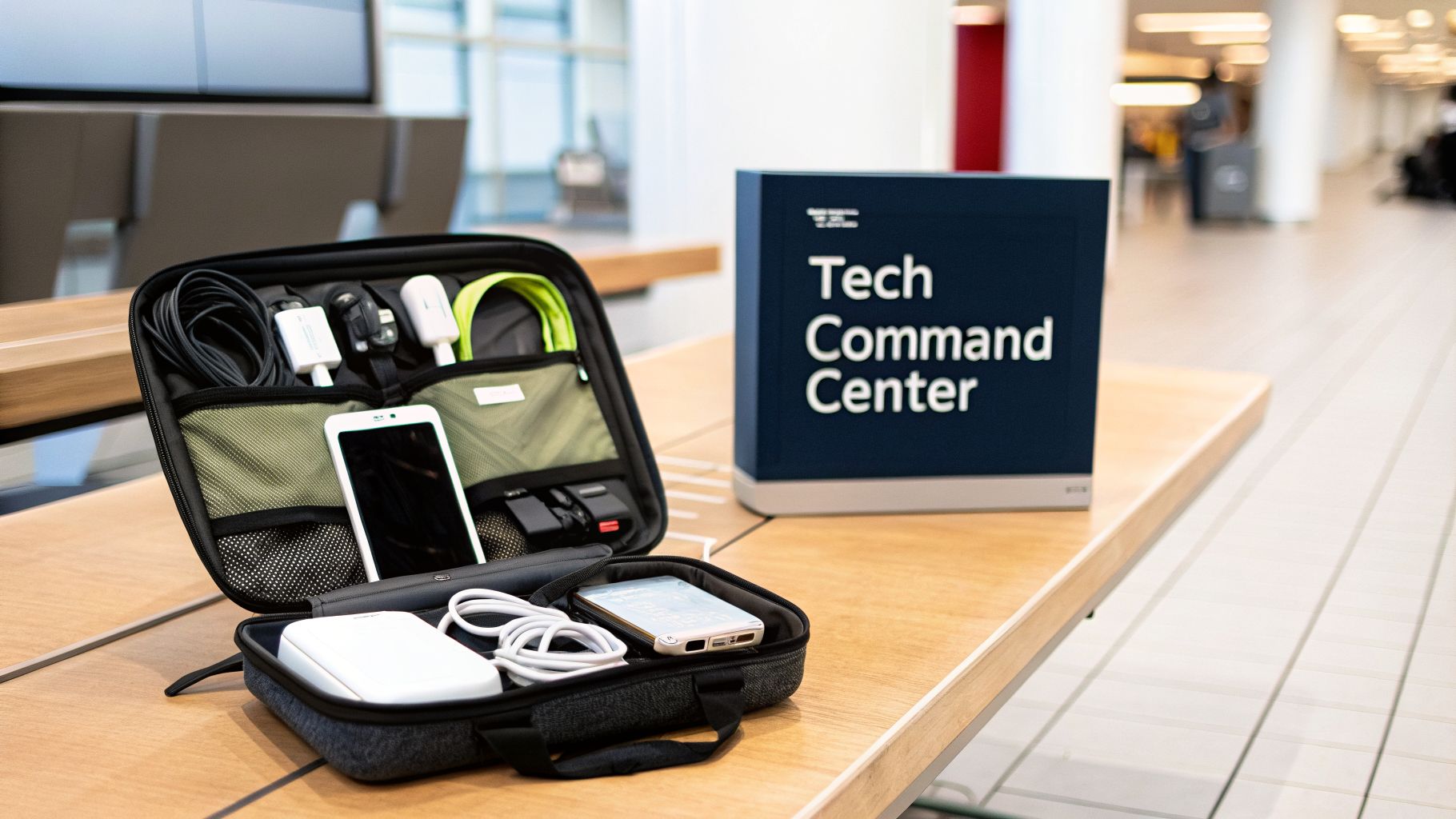
Picture yourself at the TSA security line. Instead of pulling out a jumble of electronics and wires, you just place one single, organized case in the bin. That’s the reality a good tech case offers. It’s not just another pouch; it’s your personal command center for every gadget you travel with.
Think of it as a proper toolkit for your digital life. A mechanic wouldn't just toss their expensive wrenches and sockets loose into a duffel bag, right? So why do we let our pricey electronics rattle around unprotected? A tech organizer brings a system to the madness, giving every item a secure spot.
Transforming Chaos into Calm
The most immediate win? No more "cable spaghetti." That knotted mess of wires is more than just an annoyance; it's a primary cause of damage. All that friction and bending wears down your cables, leading them to fail at the worst possible moment.
A well-organized tech case isn't about being tidy for its own sake. It’s a smart, preventative habit. It actively protects the hundreds or even thousands of dollars you've invested in your gear from scratches, dings, and the general abuse of travel.
This one small addition has a huge ripple effect on your whole trip. When you systematize your tech, you get rid of a major source of travel friction. The advantages are crystal clear:
- Damage Prevention: It keeps fragile items like earbuds, portable hard drives, and charging bricks from knocking against each other in your bag.
- Time Savings: No more frantic, last-minute searches. You know exactly where your power bank is, making both packing and unpacking incredibly fast.
- Stress Reduction: There’s a real sense of calm that comes from knowing your bag is perfectly organized. It’s one less thing to worry about during a hectic journey.
Ultimately, a great tech case lets you focus on your destination, not on your disorganized gear. It works hand-in-hand with other smart travel solutions, like the best laptop bag for travel, to create a truly seamless system. By safeguarding your digital essentials, you ensure your trip runs smoothly from takeoff to touchdown.
Choosing the Right Features for Your Travel Style
Let's be honest, not all tech cases are built the same. Finding the perfect one isn't just about grabbing the first pouch you see on a shelf. It's about matching its design to the gear you carry and the kind of trips you take.
Think of it this way: you wouldn't take a sports car on a family camping trip. You'd want an SUV. The same logic applies here. Let's break down what separates a genuinely useful organizer from a glorified pencil case.
Hardshell vs. Softshell: Your First Big Decision
Your first choice comes down to the case's exterior: hardshell or softshell? A hardshell case is like a suit of armor for your electronics. Its rigid, unforgiving exterior is fantastic at absorbing impacts, making it the only real choice if you're packing fragile items like external hard drives or camera lenses, especially in checked luggage.
A softshell case, on the other hand, is more like a flexible, well-padded jacket. It’s far less bulky and much easier to squeeze into a backpack that's already threatening to burst. For most of us, whose gear is mainly cables, a power bank, and some adapters, a good softshell hits that sweet spot between protection and packability.
Mastering the Internal Layout
What's on the outside matters, but it's the internal organization that makes or breaks a tech case. The whole point is to stop that tangled mess of cables and gadgets from forming at the bottom of your bag. A well-designed case uses every square inch of its space with purpose.
Look for a smart mix of these features:
- Elastic Loops: These are the unsung heroes of cable management. They firmly grip your charging cords, keeping them neat, tidy, and free from damage.
- Zippered Mesh Pockets: These are brilliant for all the small, easy-to-lose bits like SD cards, SIM card tools, or USB drives. The mesh means you can see exactly what's inside without having to dump everything out.
- Customizable Dividers: Usually found in larger cases, these Velcro partitions let you build custom-sized compartments. They’re perfect for corralling bulky items like a mouse, a large power brick, or a set of international adapters.
A great tech case is designed for one thing: quick, visual access. You should be able to open it and immediately spot what you need without digging around. This is a lifesaver at airport security or when you're fumbling for a charger on a dimly lit plane.
To help you decide, here’s a quick rundown of the most important features and who they’re best for.
Tech Case Features at a Glance
| Feature | What It Does | Best For |
|---|---|---|
| Hardshell Exterior | Provides maximum impact protection with a rigid outer shell. | Travelers with fragile gear (camera lenses, hard drives) or those who use checked luggage. |
| Softshell Exterior | Offers padded protection in a flexible, lightweight, and packable form. | Commuters, carry-on-only travelers, and anyone prioritizing space over heavy-duty protection. |
| Elastic Loops | Securely holds cables and small accessories in place, preventing tangles. | Everyone. Seriously, this is a non-negotiable for keeping cords organized. |
| Mesh Pockets | Creates see-through storage for small, loose items like SD cards or USB drives. | Photographers, digital nomads, and anyone with lots of tiny accessories. |
| Customizable Dividers | Allows you to create compartments of different sizes for bulky items. | Travelers with diverse gear like a mouse, multiple power bricks, or adapters. |
| Water-Resistant Fabric | Protects your electronics from accidental spills, splashes, and light rain. | All travelers. It's an inexpensive insurance policy for your expensive gear. |
| Lay-Flat Design | Opens a full 180 degrees to lay flat, making security checks easier. | Frequent flyers who want to get through TSA checkpoints as quickly as possible. |
Choosing the right combination of these features will ensure your tech case isn't just another accessory, but a core part of a smooth, organized travel experience.
Game-Changing Features for Modern Travelers
Finally, a couple of clever features have emerged that can make a huge difference on the road. First up is water-resistant material. This gives you incredible peace of mind when you're caught in a sudden downpour or someone knocks a drink over on the table next to you. Your electronics are incredibly vulnerable to liquid, and a resistant exterior is a critical first line of defense.
Another fantastic innovation is a lay-flat or "clamshell" design. This allows the case to open a full 180 degrees, displaying all your neatly organized gear for security screening. Instead of pulling everything out one by one, you just unzip the case, lay it flat in the bin, and send it through. It saves time and drastically reduces the chance you'll accidentally leave a crucial cable behind at the checkpoint.
Matching Your Tech Case to Your Itinerary
You wouldn't use a massive hiking pack for a quick trip to the grocery store, right? The same logic applies to your tech gear. The perfect tech case for travel isn't a one-size-fits-all item; it’s a direct reflection of your itinerary, your trip's length, and what you plan to do when you get there.
Thinking about your journey first is the key. It stops you from hauling a bulky case full of things you don't need, or worse, running out of space and power on a long international trip. Let's figure out what kind of traveler you are and find the right case for you.
The Commuter and Weekend Traveler
If your travel is mostly daily commutes or quick weekend getaways, your mantra should be minimalist. You're not packing for every what-if scenario; you're packing for pure speed and convenience. The whole point is to have a slim, lightweight organizer that disappears into a backpack or tote bag without adding any real bulk.
For these short trips, you're probably only carrying the absolute essentials:
- Your phone’s charging cable and a wall plug.
- A pair of headphones or earbuds.
- A small power bank for a quick battery boost.
A simple tech pouch with a few elastic loops and a single zippered pocket is all you need. Think of it as your daily digital survival kit—just enough to keep your core items protected and easy to grab.
The Globetrotter and Long-Haul Adventurer
Once you’re traveling for a week or more, especially internationally, your list of essential electronics starts to grow. This is where capacity and serious organization become non-negotiable. You need a case that can handle a lot more gear without turning into a tangled mess.
A long-haul traveler’s tech case isn't just a container; it's a mobile power station and a library of accessories. Its job is to support a fully digital lifestyle far from home, ensuring you're prepared for different power outlets, extended periods away from an outlet, and multiple device needs.
For this kind of travel, look for a larger case with multiple compartments and a smart layout of elastic loops, zippered pockets, and maybe even customizable dividers. This gives you the flexibility to pack bulkier items like international power adapters, a high-capacity power bank (at least 20,000mAh is a good target), and chargers for everything from your camera and e-reader to your laptop.
The Business Traveler and Digital Nomad
For anyone who works on the move, a tech case is a critical part of their mobile office. It has to do more than just hold your stuff; it needs to support your productivity and protect the expensive tools of your trade. Here, organization and rapid access are everything.
A business traveler might be carrying a portable mouse, a multiport USB-C hub for presentations, a few external drives for data, and specific dongles for connecting to different screens. Their tech case must be organized with near-surgical precision so they can set up a workspace in minutes, whether it's in an airport lounge or on a hotel desk. A lay-flat design is also a huge plus, as it makes getting through airport security that much smoother.
When you’re protecting valuable gear, one of the first questions is hardshell or softshell. This decision tree makes that choice a lot easier.
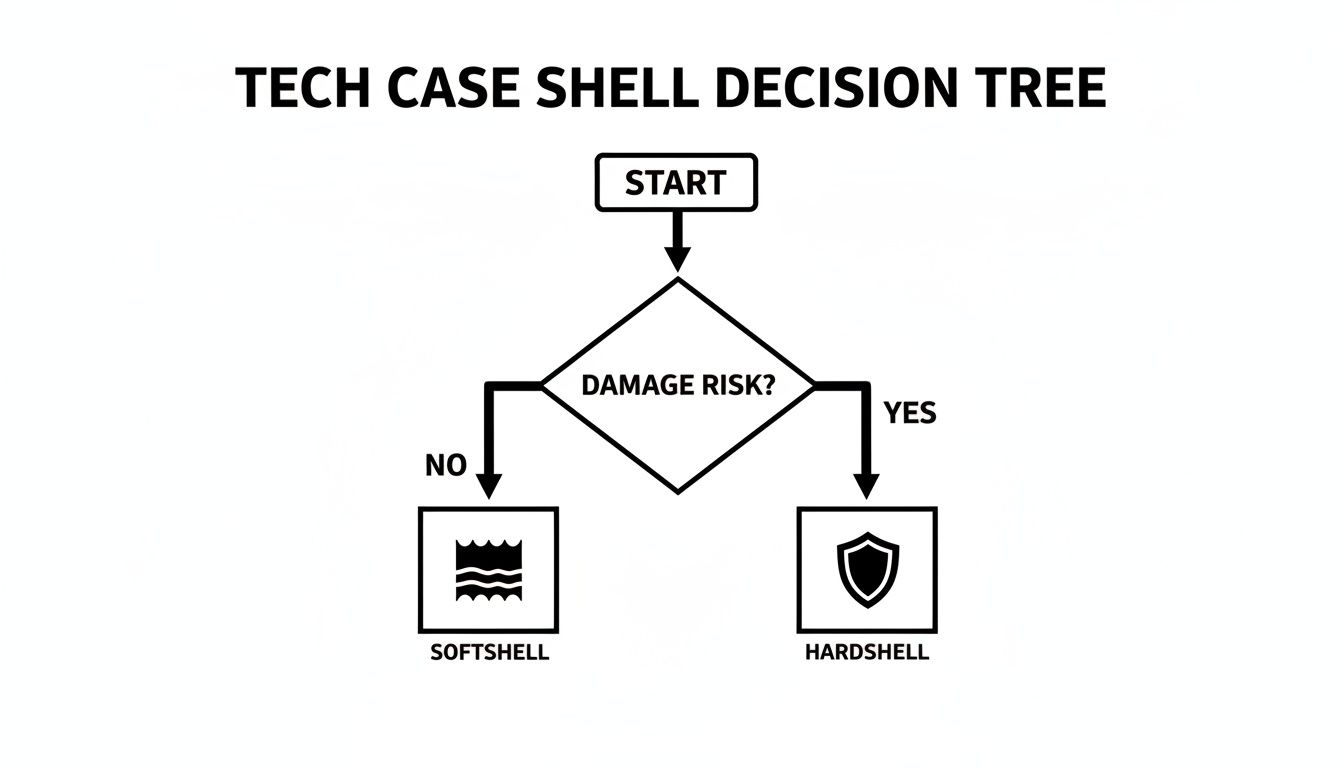
It really comes down to this: if your biggest worry is protecting gear from drops and impacts, go with a hardshell. For everyone else, a flexible softshell offers more versatile packing options.
Thinking Beyond Your Gear to Total Travel Comfort
Up to this point, our focus has been all about keeping your electronics safe and organized. But any seasoned traveler will tell you that the most important thing you bring on a trip isn't your laptop or your phone—it's you. A good tech case for travel brings sanity to your gear, but what about the physical wear and tear of just getting there?
We've all been there. After hours crammed into a tight airplane or train seat, you finally arrive at your destination feeling not just tired, but physically sore. Your shoulders are stiff, your neck aches, and that discomfort can easily bleed into the first day of your trip, whether you're trying to enjoy a vacation or nail a business meeting.
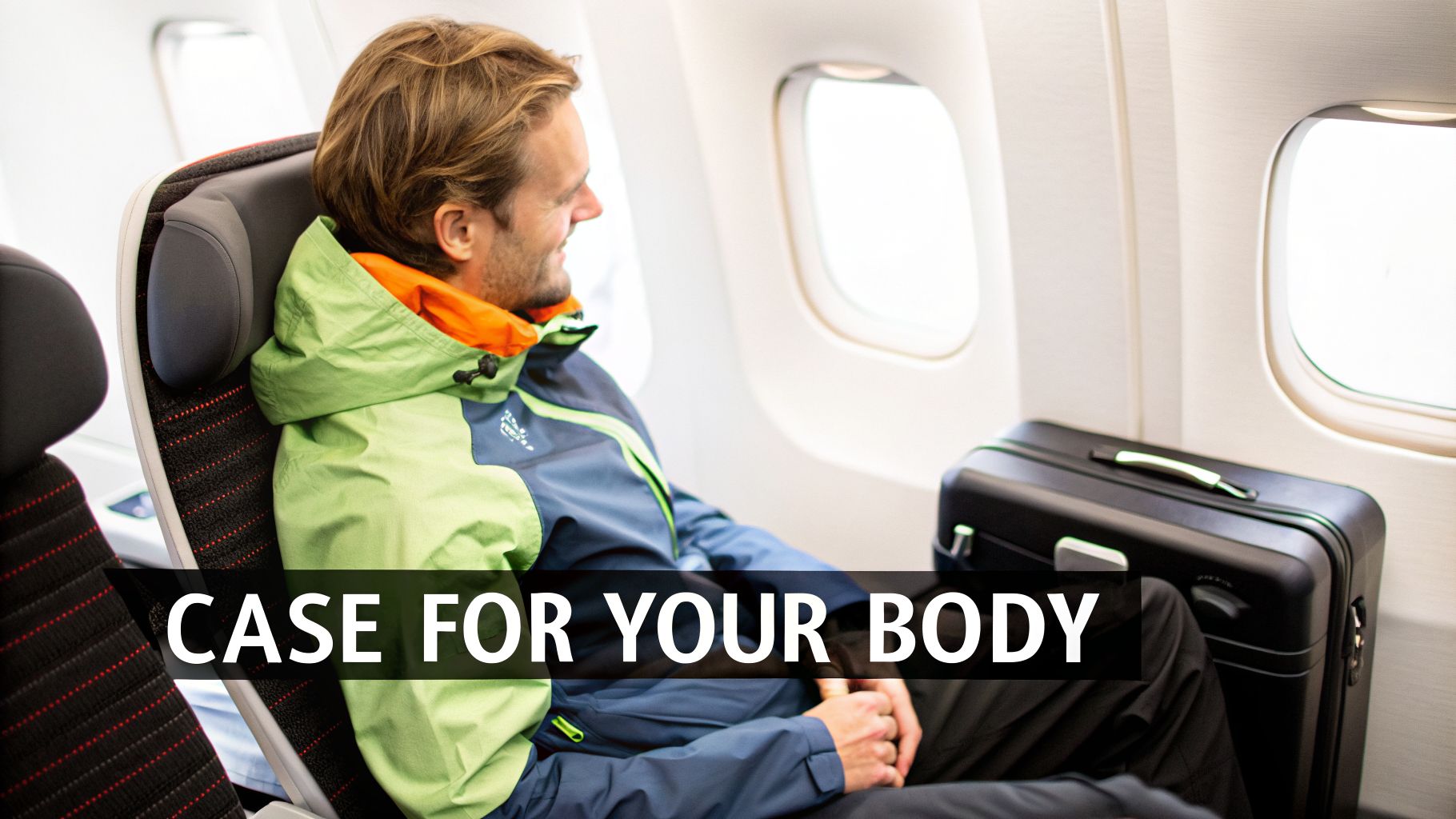
A Protective Case for Your Body
This isn't just an occasional annoyance; it's a widespread problem. A 2026 study from the International Air Transport Association (IATA) found that a staggering 78% of long-haul passengers suffer from moderate to severe upper-body discomfort—mostly in the neck, shoulders, and arms—on flights longer than six hours. With global passenger numbers projected to hit 4.7 billion in 2026, that’s more than 3.6 billion people a year arriving at their destinations feeling beaten up by the journey.
This is where we need to broaden our definition of "travel tech." If you think of your tech case as the protective shell for your gadgets, what’s the equivalent for your own body? The answer is in apparel engineered from the ground up to combat the physical strains of travel.
Just as a tech case organizes your digital world, smart travel apparel organizes your physical comfort. It’s the other half of the equation for a truly seamless journey, addressing your well-being with the same level of intention you give your electronics.
Pairing Gadget Sanity with Personal Comfort
This is exactly where a solution like the STR-8 Jacket fits in. It isn't trying to replace your tech case; it's designed to work alongside it. While your organizer is keeping your cables from turning into a tangled mess, the jacket is working to relieve the upper-body strain that makes long trips so exhausting.
It’s essentially a "case for your body." The jacket features an internal support system that gently cradles your arms, distributing their weight and taking the constant pressure off your neck and shoulder muscles. This simple but effective design allows you to truly relax, whether you're trying to get work done on your laptop or finally catch some sleep.
When you pair an efficient tech organizer with comfort-focused apparel, you’re building a complete travel system. One piece of gear handles your electronics, and the other handles you. This two-part approach is a key part of smart packing, much like building a capsule wardrobe for travel where every item has a clear and important job. The goal isn't just to arrive with fully charged devices, but to feel personally recharged and ready for whatever comes next.
Packing Your Tech Case Like a Pro
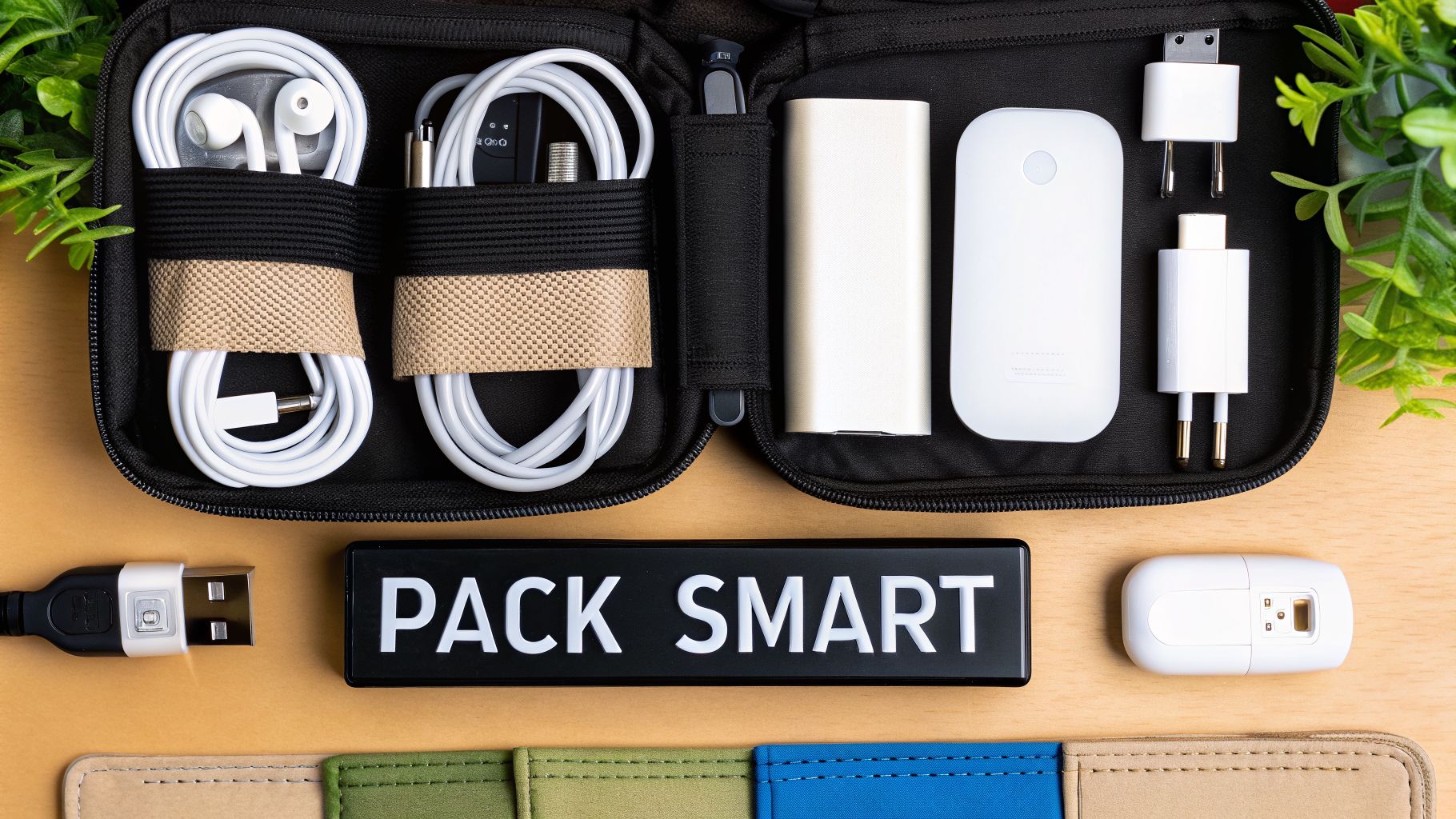
Having the right tech case is only half the battle. How you pack it is what separates the seasoned travelers from the rookies fumbling around at the gate. A well-organized case isn’t just about being neat; it’s about creating a smart, grab-and-go system that simplifies your journey.
The whole process kicks off before you even think about zipping it shut. I call it the "pre-flight tech audit." Just lay out every gadget and cable you plan to bring, and for each one, ask a simple question: "Am I 100% sure I'll use this, or am I bringing it 'just in case'?" Embracing that minimalist mindset is your first step to a lighter, smarter load.
Master the Art of the Bundle
Once you’ve whittled down your gear, the real magic begins. Start grouping related items together to create mini-kits within your main case. This one simple trick saves you from the frantic dig-through when all you need is one specific adapter.
Try creating a few of these bundles:
- The Charging Kit: Keep your power bank, its own charging cable, and a wall plug all together. Now you have a self-contained power station.
- The Audio Kit: Group your headphones or earbuds with any dongles or adapters you might need. No more untangling them from your laptop charger.
- The Camera Kit: Bundle your camera batteries, charger, and extra SD cards so you're always ready to capture the moment.
This method transforms your tech case for travel from a simple pouch into a highly efficient, modular toolkit. Everything you need is exactly where you expect it to be.
The golden rule of tech case packing is simple: Tame your cables before they tame you. A few seconds spent wrapping each one saves you from a tangled mess later on.
One of the best tools for this job is a cheap pack of reusable velcro cable ties. They are a massive upgrade over the flimsy twist ties that come in the box. By coiling each cable neatly and securing it, you keep your case organized and prevent the wear and tear that leads to frayed wires and dead chargers. If you're interested in applying this minimalist approach to your whole bag, check out our guide on how to pack for carry-on only.
Go Digital to Pack Lighter
Finally, think about what you can "pack" digitally to reduce your reliance on physical hardware. The less you use your screen, the less you need that oversized power bank.
Before you head out, download everything you’ll need for your journey:
- Your boarding passes and tickets into your phone's digital wallet.
- Offline maps for your destination in Google Maps or a similar app.
- Your favorite podcasts, playlists, and a few movies for entertainment.
This little bit of prep makes your travel day smoother and helps your battery last longer, meaning you might not even need that extra power bank after all. Packing light has become a massive advantage for modern travelers. In fact, 80% of carry-on travelers say they prioritize lightweight gear to stay comfortable and reduce fatigue on the road.
Your Top Questions About Tech Cases and Smart Travel, Answered
Once you start thinking about upgrading your travel gear, a few questions always seem to surface. Choosing the right tech case for travel is a balancing act between protection, size, and what you personally need on the road. Let's clear up some of the most common points of confusion to help you feel confident in your choice.
We'll tackle everything from material choices to what "travel tech" even means anymore. Think of this as the final check before you commit to a smarter way of traveling.
Hardshell vs. Softshell: Which Tech Case Is Actually Better?
This is the classic debate, and honestly, the right answer comes down to what you're carrying and where it's going.
A hardshell case is like body armor for your electronics. It offers incredible impact protection, making it a no-brainer for photographers, videographers, or anyone with fragile gear like external hard drives, especially if they're going in a checked bag. The trade-off? They’re rigid and can be a bit bulky, eating up valuable space.
For most of us, though, a softshell case hits the sweet spot. They’re much more flexible, lighter, and easier to squeeze into a packed carry-on. If your kit is mostly cables, chargers, and a power bank, a good softshell offers plenty of protection without the bulk. It’s the best all-around choice for packing efficiency and solid defense.
How Do I Keep My Tech Case from Becoming a Bulky Mess?
The secret here is intentional minimalism. Before each trip, do a quick audit of your electronics. Be ruthless. Those "just in case" items are almost always the culprits behind a heavy, overstuffed bag.
Here are a few practical tips I’ve learned to keep things lean:
- Get a multi-port charger. A single wall plug that has several USB-A or USB-C ports can power up all your devices at once. This one change dramatically cuts down on the number of power bricks you have to haul around.
- Pick the right size case. Don't buy a giant organizer if you only travel with a few essentials. A smaller pouch forces you to be more selective and pack only what you truly need.
- Prioritize multi-functional gear. Every item you pack should earn its spot by offering maximum value for its size and weight.
Does a Tech Case Really Make Airport Security Faster?
Yes, without a doubt. It makes a huge difference. A well-organized tech case—especially one with a lay-flat or clamshell opening—makes the whole TSA screening process smoother and less frantic.
Instead of digging through your bag and pulling out a tangled mess of wires, you just unzip the case and lay it flat in the bin. Agents can see everything at a glance, and you don't have to unpack a single thing.
Not only does this get you through the line quicker, but it also nearly eliminates the risk of leaving a critical charger or adapter behind in the bin. Having all your electronics neatly contained in one place brings a sense of calm to what is usually the most stressful part of the airport experience.
What's the Difference Between "Travel Tech" and "Gadgets"?
It’s a subtle but important distinction. While gadgets are definitely part of travel tech, the term itself has a much wider meaning. "Gadgets" are your electronics—phones, smartwatches, power banks. "Travel tech," on the other hand, is about using any kind of innovation to solve a common problem you face on the road.
The STR-8 Jacket is a great example. It uses material science and ergonomic design—both forms of technology—to solve the physical toll of long-haul travel. It doesn't have a battery, but it's absolutely a high-tech solution to the very real problem of travel fatigue. It’s performance gear for the modern traveler, proving that the best solutions aren't always electronic.
When you pair an organized tech case with comfort-driven apparel, you build a complete system for a better journey. While your case looks after the gear, let STR-8 Jacket look after you. See how our engineered comfort can change your next trip at https://www.str-8jacket.com.