

When you're searching for the best laptop bag for business travel, it's a constant balancing act. You're juggling professionalism for that big meeting, efficiency for the airport sprint, and comfort for the long haul.
For those multi-day trips where you need to carry more and keep your hands free, a business backpack is often unbeatable. But when you're walking into a client's office and a sharp, polished impression is non-negotiable, a modern, well-organized briefcase is still the gold standard.
Understanding Your Travel Needs
Let's be honest: the "right" bag is deeply personal. It all comes down to your typical travel style and the demands of your job. The choice you make is a direct reflection of your itinerary. Are you hopping on a morning flight for one meeting and heading home, or are you living out of a suitcase for a week-long conference?
This guide isn't just about listing a few popular bags. We’re going to give you a framework to really think through your needs. The goal here is to help you find a long-term travel partner that genuinely makes every trip smoother and more productive.
Defining Your Primary Use Case
Before you get lost comparing features and materials, take a minute to nail down your most common travel scenario. A bag that's perfect for one trip can be a real pain on another.
- The Day Tripper: If you’re in and out on the same day, a slim briefcase or a sleek tote gives you that professional look without any extra bulk.
- The Multi-Day Road Warrior: For trips stretching over several days, a good business backpack is your best friend. It offers far better ergonomics for carrying tech, documents, and a change of clothes through airports and city streets.
- The Client-Facing Executive: When that first impression is everything, nothing projects authority and preparedness quite like a premium leather briefcase.
Choosing the best laptop bag for business travel isn't about finding a single "perfect" bag. It's about matching the right tool to the job. Versatility is great, but a bag that's optimized for what you do most often will always serve you better in the long run.
Style vs. Function: A Quick Comparison
Your decision will often boil down to a trade-off between how it looks and how it works. A sleek, minimalist aesthetic can seriously elevate your professional image, but you can't discount the practical features that ensure a trip is stress-free.
To help you think through these priorities, our complete guide on the best laptop bag for travel takes a much deeper look at specific materials and design choices.
| Attribute | Business Backpack | Modern Briefcase |
|---|---|---|
| Primary Advantage | Capacity & Comfort | Professionalism & Polish |
| Ideal Scenario | Multi-day trips, airport navigation | Client meetings, formal settings |
| Ergonomics | Excellent (Distributes weight) | Good (Shoulder strap or handle) |
| In-Flight Access | Good (Fits under seat) | Excellent (Slim profile) |
Ultimately, we're going to put these top styles head-to-head in real-world situations. That way, you can pick a bag that not only protects your tech but makes your entire travel experience better.
How Hybrid Work Changed the Business Travel Bag Forever
The way we work has completely changed, and our trusty travel bags have had to change right along with it. With the rise of hybrid and remote work, your "office" isn't just one place anymore. It could be your kitchen table, a local coffee shop, or a client's boardroom halfway across the country. This shift has turned the simple laptop bag from an afterthought into a mobile command center.
Today’s business traveler needs more than just a flimsy sleeve to protect their computer. We’re often carrying an entire workstation—laptops, chargers, maybe even a portable monitor, plus all our personal items. It’s a lot to juggle, and bag makers have stepped up with some serious innovation to help us manage it all without looking like a mess or throwing out our backs.
The New "Do-It-All" Business Bag
As the lines between our work and personal lives blur on the road, bag designs have become much more versatile. A modern bag isn't just for the 9-to-5 grind; it has to work for the 5-to-9 journey, too. That could mean hitting the hotel gym after a day of meetings or packing for a quick overnight trip.
This need for multi-purpose gear has pushed manufacturers to get serious about a few key things:
- Real-World Ergonomics: Comfortable straps and smart weight distribution aren’t just nice-to-haves anymore; they're expected. No one wants to arrive at a meeting with a sore shoulder.
- Built-in Tech Smarts: You’ll now find features like integrated USB charging ports and perfectly sized, padded pockets for every gadget imaginable. It’s all about staying powered up and organized.
- Smarter Materials: We're seeing more lightweight, durable, and weather-resistant fabrics like ballistic nylon and CORDURA®. These materials offer incredible protection without weighing you down.
The modern business bag is no longer just a box for your laptop. It's an extension of your professional self, built to bring order, security, and comfort to wherever your work takes you.
This surge in demand is making waves in the market. The global laptop bag industry is expected to hit $2.658 billion in 2025, largely thanks to the 55% of us working in some kind of mobile or hybrid role. And it’s not slowing down, with projections showing the market could grow to $4.285 billion by 2035. If you're curious, you can explore more data on this expanding market to see just how fast things are changing.
Why Companies Are Investing in Better Gear
This shift isn't just about personal style—it’s smart business. More and more companies are realizing that a high-quality travel bag is a vital tool for productivity and protecting their investments. Handing an employee a well-designed, secure, and comfortable bag is a direct investment in their well-being and the safety of that expensive company-issued laptop.
When a company provides a premium bag, it’s saying, "We've got your back while you're on the move, and we trust you with our gear." This is exactly why finding the best laptop bag for business travel has become such a hot topic for both road warriors and their employers. It's a purchase that delivers returns in comfort, security, and the confidence that you're ready for whatever the modern workday throws at you.
Comparing Laptop Bag Styles for Business Travel Scenarios
Picking the right laptop bag for a business trip isn't about finding one magical, do-it-all solution. It's about matching the bag's strengths to your specific travel routine and professional needs. Forget generic pro/con lists; we're going to look at the most popular styles through the lens of real-world business scenarios to help you see which one truly fits your life on the road.
This flowchart can help you start narrowing down your options based on what matters most to you—whether that’s comfort, security, or pure professionalism.
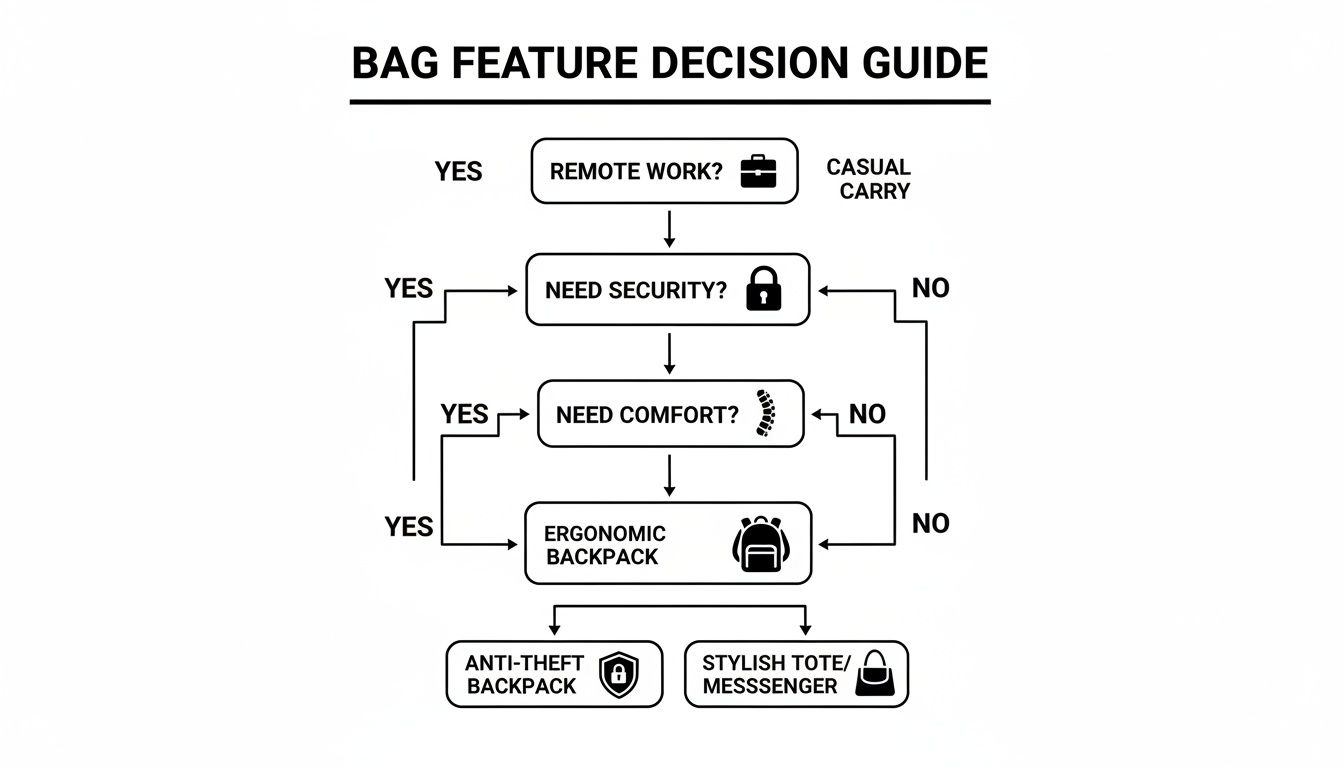
As you can see, the decision often comes down to a trade-off between how much you can carry and the professional image you want to project. Let’s break down how that plays out with each bag type.
The Business Backpack: Power and Comfort
The business backpack has become the go-to choice for modern road warriors who prioritize capacity, smart organization, and ergonomic comfort. These aren't the saggy school bags of your youth. Today’s professional backpacks are sleek, structured, and thoughtfully engineered for the traveling professional.
Consider this scenario: You’re heading out on a three-day trip that involves a flight, several client meetings, and maybe a quick trip to the hotel gym. You need to pack your laptop, a tablet, documents, chargers, and a light change of clothes. You'll be navigating a massive airport and then hopping on public transit to get downtown.
In this situation, a backpack is simply unbeatable. Its two-strap design distributes weight evenly across your shoulders, which is a lifesaver when you're hauling 15-20 pounds of gear. This hands-free mobility is a huge advantage when you're also pulling a rolling suitcase, juggling a coffee, and trying to pull up your boarding pass.
The business backpack’s real superpower is acting as a mobile office for multi-day trips. It offers the best volume-to-comfort ratio, making it the default choice for anyone who needs to carry a lot of tech without being weighed down.
Modern business backpacks have also mastered organization. The best ones feature dedicated, heavily padded sleeves for your laptop and tablet, a web of internal pockets for chargers and small items, and a quick-access pocket on the outside for your passport and phone. This level of compartmentalization is what gets you through a security checkpoint without a frantic scramble.
The Modern Briefcase: Authority and Access
For those moments when a commanding first impression is everything, the modern briefcase remains the undisputed champion. It projects an air of seriousness, focus, and authority that no other bag can quite match.
Imagine this: You're flying in for a single, high-stakes boardroom presentation. Your travel is simple and direct: airport to taxi, taxi to the client's office, and back again. You only need your laptop, a notebook, and a few key documents.
This is where a sharp leather or ballistic nylon briefcase really shines. Its slim profile is easy to manage in tight spaces, and it tucks neatly under an airplane seat or beside your chair in a meeting without being a clumsy obstacle. Carrying it by the handle or a simple shoulder strap reinforces a polished, "I mean business" look. While it can't compete with a backpack on capacity, its focused design sends a clear message: you brought exactly what's necessary, and nothing more.
This distinction is clear in market trends. While backpacks are on track to hold the largest revenue share at 48% by 2026, the shoulder and sling bag category—which includes briefcases and messengers—is a USD 1.056 billion powerhouse. It shows a split in how we travel: we grab backpacks for heavy loads but opt for sleeker bags when agility matters more. With 60% of buyers listing comfort and lightweight design as top priorities, the best choice often boils down to this trade-off. You can review more in-depth market analysis on these trends to see how brands are responding.
The Messenger Bag: Urban Agility
The messenger bag, sometimes called a shoulder bag, hits a sweet spot right between the casual comfort of a backpack and the stiff formality of a briefcase. It's the perfect sidekick for the urban professional who's constantly on the move.
Picture this scenario: You’re posted up in one city for a week, dashing between meetings across town. You need instant access to your laptop, tablet, and notes while navigating subways, Ubers, and crowded sidewalks.
A messenger bag's greatest asset is its on-body accessibility. You can swing it to your front to grab a transit card, your phone, or even your laptop without ever taking the bag off. This makes it incredibly efficient for the fast pace of city life. The only real drawback is that its single-strap design can lead to shoulder fatigue if you overload it, so it's not ideal for carrying heavy gear over long distances.
The Rolling Laptop Case: Maximum Capacity
When you absolutely must transport the most gear with the least physical strain, the rolling laptop case is your answer. Think of it as a small, wheeled suitcase built around a fortress-like, protected compartment for your technology.
Here’s the use case: You're heading to a trade show or conference where you need to bring your laptop, product samples, marketing brochures, and personal items for a few days. Your main goal is to avoid back and shoulder pain while trekking across sprawling convention centers and airport terminals.
A rolling case lets you glide effortlessly through it all, with zero weight on your body. Many models even come with a secondary compartment for a change of clothes, essentially combining your personal item and a small carry-on into one efficient unit. The trade-off is its rigidity and bulk—it’s less adaptable to tight spaces and can be a real pain on stairs or cobblestone streets.
Business Laptop Bag Style Comparison
This table provides a situational comparison of laptop bag styles based on common business travel scenarios, helping you choose the right bag for your needs.
| Bag Style | Best For Scenario | Professionalism Score (1-5) | Airport Mobility | Capacity & Organization |
|---|---|---|---|---|
| Business Backpack | Multi-day trips with heavy tech load | 4 | Excellent | Excellent |
| Modern Briefcase | High-stakes client meetings, day trips | 5 | Good | Good |
| Messenger Bag | Quick urban commutes, easy access | 3.5 | Very Good | Good |
| Rolling Case | Trade shows, maximum load | 4.5 | Excellent (on flat surfaces) | Superior |
In the end, the "best" laptop bag for business travel is the one that aligns with your specific itinerary. A seasoned road warrior might own both a backpack for long-haul journeys and a slim briefcase for critical client-facing meetings, deploying the right tool for the job.
The Must-Have Features Every Business Travel Bag Needs
Once you've settled on a style—briefcase, backpack, or something in between—it’s the little details that separate a merely good bag from a truly exceptional one. These are the non-negotiable features that make a real difference on the road, turning a frantic dash through the airport into a smooth, professional journey.
Let's break down the essential features that any serious contender for the best laptop bag for business travel must have.
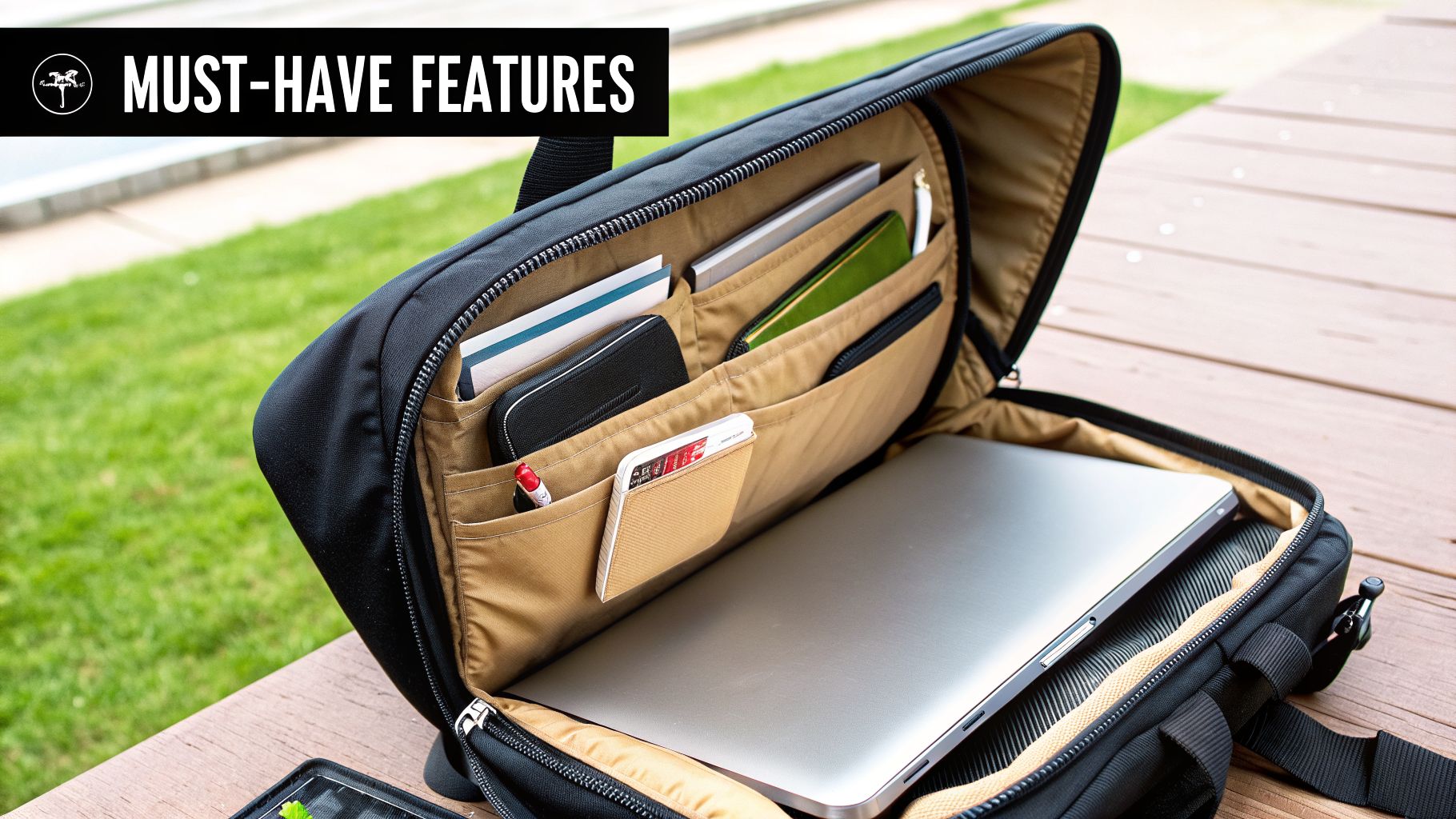
Ultimate Device Protection
Your laptop is your mobile office; protecting it is the bag's number one job. A simple fabric divider just won't cut it when you're navigating crowded terminals and overhead bins. You need a dedicated, separate laptop compartment engineered for impact.
The gold standard is 360-degree high-density foam padding. This means the compartment is fully cushioned on all sides, including the bottom. Even better are bags with a "suspended" or "false bottom" design. This clever feature elevates the laptop sleeve slightly, so your device never actually hits the floor when you set the bag down—a simple detail that can easily prevent a cracked screen and a costly repair.
Airport-Ready Convenience Features
Any frequent flyer knows that efficiency at the airport is everything. A couple of thoughtful design elements can make your trip through security and across the terminal remarkably less stressful.
-
TSA-Approved/Checkpoint-Friendly Design: A lifesaver. This feature, most often found in backpacks, lets the bag unfold and lay completely flat on the X-ray scanner belt. You can leave your laptop right where it is, sparing you the all-too-familiar scramble to unpack and repack in a busy security line.
-
Luggage Strap (Trolley Sleeve): This might be the single most underrated feature for a business traveler. It’s a simple horizontal strap on the back of your bag that lets you slide it securely over the handle of your rolling suitcase. Your hands are free, your shoulders get a break, and your bag won't tumble off as you race to your gate.
A trolley sleeve is non-negotiable for anyone who travels with both a personal item and a carry-on suitcase. It is the single biggest "quality of life" improvement, turning two cumbersome items into one cohesive, easy-to-manage unit.
Materials and Durability
A bag's material dictates its longevity, weight, and ability to shield your gear from a sudden downpour. While classic leather looks undeniably sharp, modern technical fabrics often deliver far better all-around performance for the rigors of frequent travel.
Ballistic Nylon and high-denier Polyester are the industry workhorses for a reason. They offer an incredible balance of durability, resistance to scuffs, and a surprisingly light weight. Look for a high denier count (like 1680D Ballistic Nylon), which indicates a thicker, tougher weave. Many top-tier bags also add a water-resistant coating or use weather-treated zippers, giving you crucial protection against the elements.
Thoughtful Organization and Security
A great business bag doesn't just hold your stuff; it organizes your life on the go. Instead of one giant cavern where everything gets lost, look for smart interior compartmentalization that keeps you prepared and professional.
Intelligent pockets are key. You want dedicated spots for your power bank, charging cables, pens, and business cards. When everything has a home, you can find what you need in seconds without digging. If you’re juggling a lot of small electronics, you might want to level up your organization with a dedicated organizer—check out our guide to choosing a travel tech case for more ideas.
For genuine peace of mind, make sure your bag includes these security features:
- Lockable Zippers: The main compartments—especially the one holding your tech—should have zippers with interlocking loops. This lets you secure them with a small travel lock to deter opportunistic theft in airports or cafes.
- RFID-Blocking Pockets: This is a specialized pocket lined with material that blocks scanners, protecting your passport and credit cards from digital pickpockets who try to "skim" your data.
Finally, don't overlook a simple but critical detail: a stable, structured base. A bag that stands upright on its own without constantly tipping over is a small luxury that makes a huge difference. It keeps your bag clean, makes it easier to grab what you need, and just looks more put-together when you set it down in a meeting or under your seat on the plane.
Packing Strategies to Maximize Space and Minimize Stress
Having a great laptop bag is a solid start, but how you pack it is what really makes the difference between a smooth trip and a frantic scramble. It’s not about just jamming everything inside; it's about being strategic. The goal is to balance weight, keep essentials accessible, and protect your gear.
The first rule of thumb is to pack by zones. Think of your bag as having distinct areas for different needs. Your heaviest items, like your laptop and any bulky files, should always go in the compartment closest to your back. This simple move keeps the bag's center of gravity close to your body, which does wonders for reducing back strain and making the load feel lighter, regardless of whether you're carrying a backpack or a briefcase.
Lighter items you won't need until you get to your hotel can be tucked away in the main compartment. Your absolute essentials—phone, wallet, passport, keys—belong in a dedicated, quick-access pocket on the outside. This way, you’re not digging through everything just to find your boarding pass at the gate.
Mastering Your Tech and Documents
A tangled mess of cables at the bottom of a bag is the business traveler’s kryptonite. Do yourself a favor and invest in a few cable ties or a small tech pouch. It’s a tiny change that keeps things incredibly neat and also stops your chargers from getting bent and damaged.
When it comes to important papers, I like to use a slim document folder in a bright color. It’s impossible to miss when you glance inside your bag, and it keeps contracts or presentations from getting creased. And of course, always have digital copies of everything on your phone or in the cloud. It’s your best insurance policy.
A well-packed bag is an extension of a clear mind. When you know exactly where everything is, you can move through airports and meetings with confidence and focus, projecting an image of total control.
This disciplined approach is a game-changer, especially if you're trying to travel light. For anyone ready to embrace total efficiency, learning how to pack for carry-on only travel will completely transform your trips.
Long-Term Bag Maintenance and Care
Your laptop bag is more than just luggage; it's part of your professional uniform. Taking good care of it is a small investment that pays off by keeping you looking sharp for years. The right care routine really comes down to the material your bag is made from.
-
Ballistic Nylon & Polyester: These rugged fabrics are pretty low-maintenance. If you spill something, just spot-clean it right away with a damp cloth and a bit of mild soap. For a deeper clean, a soft brush can help get dirt out of the weave. Always let it air dry completely, and stay away from harsh chemical cleaners—they can strip the water-resistant coating.
-
Leather: A leather bag needs a bit more TLC to keep it looking rich and sophisticated. Give it a quick wipe with a dry, soft cloth each week to get rid of dust. To handle minor scuffs and keep the leather from drying out and cracking, use a quality leather conditioner every few months. Just remember to test any new product on a hidden spot first.
How you store your bag matters, too. When you’re not using it, empty it out completely and stuff it with paper to help it hold its shape. Keep it in a dust bag and store it somewhere cool and dry, far from direct sunlight that can fade the color and dry out the material. A few minutes of care after each trip goes a long way.
Your Top Questions About Business Travel Bags, Answered
Making the final call on a new travel bag can be tough. To help you lock in your decision, I've pulled together answers to the most common questions I hear from fellow professionals on the road.
Is a Backpack or a Briefcase a Better Choice for Business?
Honestly, it all comes down to your itinerary. If you're running through airports or carrying your gear for a few days, the superior comfort and larger capacity of a business backpack are hard to beat. Nothing tops it for hands-free mobility.
On the other hand, if you're walking straight into a high-stakes client meeting, a sleek, modern briefcase makes a stronger professional statement. Many of us who travel constantly end up owning one of each, picking the right tool for the job.
How Can I Make Sure My Laptop Is Actually Protected in My Bag?
The non-negotiable feature here is a dedicated, well-padded laptop compartment. Look for designs that offer 360-degree padding, which protects the edges and corners, not just the front and back. Even better is a suspended sleeve that keeps your laptop from smacking the ground when you put your bag down.
A quick pro tip: Never toss keys, bulky power bricks, or other hard objects in the same compartment as your laptop. It's a surefire way to get scratches or even pressure cracks on your screen.
Are Those Expensive Laptop Bags Really Worth the Money?
In most cases, absolutely. When you invest more, you're not just paying for a brand name. You're paying for genuinely better materials like full-grain leather or high-denier ballistic nylon, much stronger construction with reinforced stitching, and a more intelligently designed layout.
You'll feel the difference in the ergonomics, find things faster thanks to better organization, and usually get a much more robust warranty. For anyone who travels frequently, a high-quality bag isn't a splurge—it's a critical investment in protecting your tech, your comfort, and your professional image.
What Size Bag Counts as a "Personal Item" on a Plane?
Good news: nearly any standard laptop bag, backpack, or briefcase will qualify as your personal item. The universal rule is that it must fit completely under the seat in front of you.
As a reliable guideline, a bag under 18 x 14 x 8 inches will be accepted on most major airlines like Delta, United, and American. But regulations can change, so it's always smart to double-check the specific rules for your airline before heading to the airport.
Long flights and uncomfortable commutes can really take a toll on your neck and shoulders. The STR-8 Jacket was created to give you discreet, hands-free arm support to help ease that strain and make your journey more comfortable. See how you can get better in-flight rest at str-8jacket.com.